This edition of the Mexico Water Report has a mixture of private and public sector articles. The first article deals with the problems that foreign companies are facing when trying to participate in water government procurement bids and the reality that many government bids are no longer viable for US companies under newly published rules and despite the existence of NAFTA – and how we can do something to change these regulations.
The second article deals with channel realities for selling to the water sector in Mexico. Our next edition will have an article that completes our analysis on this all important theme. The next two articles deal with private sector analysis.
The third article continues our analysis of economic segments that require water equipment - their current dynamic and water problems and opportunities – reviewing the dairy, textile/clothing and metal working/automotive sectors.
The fourth article provides an overview of water in agriculture in Mexico – where almost 80% of national waters are destine (4th highest in the world) but where less than 2% of water revenue is based. The final article describes the water infrastructure and opportunities that exist in the all important Mexican Federal District/Mexico City area.
In this edition we will address:
Upcoming Visits by the Mexico Trade Office Director
Vince Lencioni, Director of Wisconsin's Trade Office in
Mexico,
will be in California in March, Washington, DC and Pennsylvania in
April and June, and the upper Midwest in May. If any
companies would like to meet with the director during these trips,
please see the below visit details and contact us so that we can try to
schedule a visit.
March: 2030 Mexico Water Program Announcement and
Analysis – In March, the Mexican federal
government will give out details concerning the proposed 2030 Water
Program. LGA Consulting will provide a full analysis of these
concrete points related to what Mexico plans to do regarding water
technology and infrastructure during the next 20 years.
Please let us know if you would like to receive this
analysis.
April 19-21: Waste Water Equipment Manufacturers
Association (WWEMA) Annual Convention in Washington, DC - The director will be participating and presenting about
the water sector in Mexico, and available to meet with
businesspeople.
May 9-13: Annual Visit to Wisconsin - The director's of Wisconsin's four international trade offices
(Mexico, Canada, Brazil, and China) will be visiting various locations
in Wisconsin to speak on developments and opportunities in their
markets as well as have one-on-one appointments with Wisconsin
businesses seeking to expand their export sales.
June 12-16: AWWA ACE11 Event in Washington, DC - The director will be attending the show and available to meet with
businesspeople.
When the International economic crisis hit Mexico in late 2008, Conagua
(Mexican Water Commission) established that its funding of public
sector water projects would continue forward without delays.
And, while one can argue that many projects did continue forward,
especially in 2009, projects in 2010 were dramatically affected by
budget, political/electoral, and typical Mexican bid
bureaucracy. It appears now that many projects delayed in
2010 will likely come back on line in 2011. However,
Wisconsin's Trade Office in Mexico warns that for foreign companies, it
sees only serious concerns and larger problems and deceptions affecting
their participation, or ability to participate, in Mexican public
sector projects now and in the foreseeable future.
This article will explain the blurring that has taken place between
National and International bids in general and especially with new and
stricter national content regulations, as well as how ineffective NAFTA
has been in protecting US and Canadian companies from this new Mexican
protectionism. It will also discuss how and why foreign
companies and companies trying to provide non-Mexican made product
should be concerned about remaining viable in the Mexican public water
sector.
Evolution of National Content Regulations in
Mexican Government Procurement
In November of 1994, six months after NAFTA went into affect, Mexico
established a rule that 50% of the contracts of federal, state, and
municipal governments should be with small or medium Mexican companies,
an interesting, progressive measure that for the most part was not
enforced or enforceable. Ironically, although the NAFTA
chapter on government procurement was supposed to create opportunities
for US and Canadian companies and protect at least them from
protectionist procurement measures in Mexico, said rule served as a
precursor for much more protectionist measures in this area that would
come from the Mexican federal government in November of 2000 and even
more strongly in October of 2010.
In November of 2000, Mexico published its first Rules for the Determination and Accreditation of the Amount of National Content for Federal Government Procurement. In these rules, the Mexican government established that all federal government procurement goods purchases needed to have at least 50% national content. While procurement laws established that public works contracts could only be bid on by Mexican based companies, said contracts did not have any national content requirements. While said regulations allowed Mexican federal dependencies to establish national content minimums, this was something that was rarely done.
While these new national content requirements for the purchase of goods (but not on public works) now existed, said regulation (a) was not implemented with a heavy hand at the federal level, (b) state and municipal procurement officials virtually ignored these stipulations, and (c) federal officials looked the other way at these state and municipal transgressions. As a result, despite the creation of these 2000 Rules foreign companies could find a viable way to do business in the Mexican procurement system.
In October of 2010, the 2000 Rules were modified to make it even more difficult for foreign companies to participate in the great majority of government bids at the federal, state, and municipal levels. And more importantly, the implementation of these rules appears to be real and consistent this time, unlike in the case of past procurement and national content laws and regulations. Prior to the October 2010 National Content rules changes, the opportunities for foreign companies could be understood to be generally viable and even somewhat ample. If a foreign company had a Mexican subsidiary or sold its products through a Mexican intermediary, then they could participate freely in all bids, including national bids. However, the new 2010 regulation and its heightened implementation dramatically affected this viability. With the extension of national content to public works and the more strict enforcement of the national content regulations, foreign companies are effectively excluded from being able to participate in national bids even via a Mexican intermediary because said bids now require 55% national content, and they will require at least 65% national content in less than 18 months (in July 2012). And, the 2010 regulations are being interpreted so that even international bids are subject to national content requirements when Mexican products and technology can meet bid requirements.
Analysis of the Changes Resulting from the October
2010 Regulations
The most important change for the water sector brought about by the
October 2010 National Content rule changes was related to the
establishment that all municipalities and states that used any federal
funding (80-90% of these cases or more) would have to abide by these
new regulations as well. This change at the municipal level
is something new and particularly damaging for foreign companies in the
water sector since more than 95% of Mexican bids in this sector are
municipally procured, and since municipal and state government bodies
are exempt from NAFTA protection. It is interesting to note
that while the Mexican federal government insists on the exclusion of
municipal and state procurement from NAFTA protection, arguing that
said entities are not truly federal and therefore exempt, it
nonetheless conveniently uses municipal dependence on federal funding
to insist that said entities have to comply with these federal
regulations. This makes these entities de facto federal
bodies from a national regulatory perspective but evidently and
conveniently not from a NAFTA perspective. Is this a
legitimate legal loop hole or a classic example of having your cake and
being able to eat it – we see it as the later.
Another negative has emerged from this heightened enforcement and
percentage increases in national content rules. Foreign
companies and/or their Mexican intermediaries or partners, are being
forced to decide between being excluded from the Mexican government
procurement system altogether or lying and stating that their products
meet national content minimums and bribing local officials to look the
other way, hoping that federal oversight will not catch their
digression. Wisconsin's Trade Office in Mexico is already
aware of a few cases of this type of behavior by foreign
companies. This is not only inappropriate and illegal in
Mexico, it also goes against US export practice laws that the US
federal government promotes and enforces, thus providing US companies
with another barrier to remaining viable in its second most important
export market, a market where NAFTA was supposed to mean the
elimination of old trade barriers and not the creation of new
ones. We fear that too many local Mexican water procurement
officials will become more aggressive in the future at using this
national content rule as a tool for corruption, being able to function
even more effectively and efficiently with it as gate keepers approving
or eliminating bids at the beginning of the process using this legal
“ruler” more adeptly than previous more onerous and
questionable instruments.
It is important to mention that foreign manufacturers and Mexican
intermediaries who sell foreign products into the Mexican public water
sector are now beginning to see the implementation of these changes,
that is, a commitment by the Mexican federal government to enforce
these regulations and subsequently a new adherence by municipal and
state governments to these regulations. Some
companies who sell components to Mexican integrators, where a large
part of a public work is labor or construction, seem to be less
affected so far by these regulations. However, in 18 months
when the percentage of minimum national content is 65%, this could and
probably will change. And, it is important to clarify that
these percentages are MINIMUM requirements and that foreign companies
and Mexican distributors of their products are saying that they are now
routinely running into bids where the percentages are above 65% and has
high as 100%. For a company trying to sell product via a
Mexican distributor to the Mexican government in a bid only for that
product, virtually any national content requirement, as is the case in
Mexico, will serve as an effective way to exclude these products from
the market.
Analysis of NAFTA Government Procurement Provisions
Above we mention that NAFTA Chapter 10 Government Procurement does not
seem to offer US and Canadian companies adequate protection from
Mexican protectionist government procurement policies. When one reads
the key articles in this Chapter, it is hard to imagine how US and
Canadian companies are not protected from these types of
actions.
Article 1003 – National Treatment and Non-Discrimination
Even US federal government officials responsible for NAFTA issues
confirm that said articles do not protect US and Canadian companies
from unjust Mexico government procurement procedures, specifically
prohibiting US companies to bid directly without Mexican intermediaries
and prohibiting Mexican government entities from using restrictive
national content regulations to exclude US companies from the
sector.
Likewise, Article 1024 (Further Negotiations), referenced extensively
above in Article 1001, which discusses the initiation of negotiations
for improvements in Chapter coverage to include local/state entities
under Chapter 10 provisions, has NEVER taken place even though said
article mandated that negotiations were supposed to start between the
three parties no later than 1998 - 12 years of no activity on the
issue.
In the case of international bids, it is now illegal, not to mention completely impractical as the system exists today, for a foreign company to bid on any international bids without a Mexican corporation, partner or intermediary as the formal bidder. As a result, any foreign company hoping to employ a rep or agent for this purpose can no longer do so. If NAFTA was supposed to help in this area, it absolutely has had no effect except to deceive US companies into believing that somehow they were better protected from these types of issues and problems after 1994 than before 1994.
Another problem lies with the Mexican government procurement system. Said system is structured so that effectively three types of bids are permitted: (a) national bids in which only Mexican-based companies can participate, (b) international bids where companies from countries with free trade agreements (like NAFTA) with Mexico can participate, and (c) open international bids where companies from any foreign country can participate. However, foreign companies cannot participate in any of these bids without a Mexican entity, despite what NAFTA seems to establish. One might argue that foreign companies should be content to be able to participate in the international bids and agree to set up Mexican corporations to participate in national bids or simply allow Mexican companies to have these national bids that one might assume are of lower value and probably fewer in number than the international bids. However, Wisconsin's Trade Office in Mexico analyzed all public sector water bids between July 2009 and June 2010, and found that during that year period, only 2.28% of all such bids were international in nature. In speaking with Mexican water government officials involved in procurement bids, it appears that this is a trend that will continue and by no means an exception.
These Chapter 10 articles have been ignored or Mexican officials have found ways to change their meaning and circumvent their enforcement so that Chapter 10 is completely ineffective and out of step with if not contradictory to the spirit and purposes behind the inclusion of a government procurement chapter in NAFTA. As a result, one has to ask, does Chapter 10 have any merit or help protect US and Canadian companies in any way from Mexican government protectionism in government procurement – we have to conclude that it does not.
U.S. and Canadian Procurement Laws vs. Mexican
Procurement Laws
The above information in this article demonstrates that Mexican
government procurement laws and regulations are clearly protectionist
in general and even towards US and Canadian products, something clearly
not in the general spirit of NAFTA nor the spirit or evidently the
reading of Chapter 10. An easy but incorrect assumption might
be made that the US and Canadian government procurement laws and
regulations are probably just as protectionist as those in
Mexico. While Wisconsin's Trade Office in Mexico has not
studied this issue exhaustively, from conversations with US federal
government officials and from some investigation of some applicable
regulations, it seems that the US does not treat NAFTA partners, nor
for that matter countries with which it does not have free trade
agreements, in the same negative way that Mexico does. The US
does offer protection for some metal/steel producers in government
procurement bids, but said protection is clearly temporary in
nature. These US measures neither apply to all products that
are procured by the federal government nor are written into the law as
something intended to be permanent, as is the case with the Mexican
National Content Regulations published in October of 2010.
It is important to mention that all of Canada´s provinces and
almost 2/3 of US states have ratified the GATT Agreement on Government
Procurement, which establishes that these entities cannot discriminate
against foreign products the way that the Mexican federal government is
currently doing. And, to our knowledge, not a single Mexican
state has made any effort to look into the ratification of this GATT
Agreement. One has to ask why this is so and why the Canadian
provinces and 2/3 of the US states should adhere to these more
stringent, non-protectionist GATT policies if their NAFTA partner
counterparts have expressed no interest or willingness to pursue
similar actions.
Conclusion
Many U.S. and Canadian manufacturers who were expecting government
procurement opportunities to come from NAFTA and the supposedly more
liberal, open Mexican economy have to be feeling deceived.
One can easily argue that Mexican laws and NAFTA have not only not
created procurement opportunities, they have restricted if not
eliminated most opportunities that existed before NAFTA. This
claim is serious because It comes with three very negative
implications: (1) NAFTA is almost useless and even detrimental for
government procurement opportunities in Mexico, (2) in the area of
government procurement there exists a serious lack of commitment by
Mexico to trade relations with its most important trade partners, and
(3) Mexico's government procurement policies demonstrate serious
contradictions in the loud and proud stance of the Mexican federal
government that if a country signs a free trade agreement with Mexico,
its market will be opened to the products of the companies from these
nations.
Shouldn´t Mexico exclude countries that have signed free trade agreements with Mexico, especially the U.S. and Canada, from these blatantly protectionist measures? And, if it does not see the reasoning and prudence of doing so, shouldn´t the U.S. and Canadian federal governments be more vocal in public and more active in bilateral and trilateral negotiations with Mexican officials about these concerns. In the next edition of the Quarterly, we are going to discuss options for how U.S. and Canadian water-focused companies and their respective associations can work together with their respective governments to get these measures modified if not repealed. If any foreign companies or Mexican intermediaries would like to interface with Wisconsin's Trade Office in Mexico to discuss these issues and future lobbying efforts, please do not hesitate to contact us.
In our last edition, we described the five most important sectors in terms of discharge concerns, all of which had some kind of special Conagua sectoral program to regulate their discharges, above and beyond standard wastewater discharge regulations. In this edition, we are analyzing the following three, large and important manufacturing sectors, providing a feel for their size, current dynamic, and details about their environmental problems and related opportunities: A. Dairy Industry, B. Textile and Clothing Industries, and C. Metalworking and Automotive Industries.
A. DAIRY INDUSTRY
Size & Current Dynamic
Mexico consumes about 15 billion liters of milk annually but only
produces 10.8 billion liters domestically. One important reason
why Mexico has to rely so heavily on milk imports is water deficit
issues. To produce one liter of milk in Mexico, 300 liters of
water are required. Many of the leading production sites are in
some of the driest areas of Mexico. With a growing urban
population, milk demand in Mexico is growing three times faster than
production.
Mexico currently produces almost 75% of the milk demanded by its
domestic market. Imports represent about 40% of all processed final and
intermediary dairy products, both because of price and because many
local producers fail to meet quality standards. The US provides
two-thirds of all milk and milk product imports with 15% coming from
New Zealand and the other 20% from Chile, Argentina, Uruguay, and
Australia. Although Mexico has historically relied on imports of
milk powder, in the last 10 years it has been able to become more
reliant on local product, thanks to the development and increased
presence of Alpura and Lala.
Mexico ranks 8th in the world in terms of milk and dairy product
production with 11.1 million tons of milk and milk products
(2009). The industry is divided between 20 large, highly
technical companies with approximately 70% of the production. The
two largest companies, Lala and Alpura, control approximately half of
that segment. An estimated 259,000 small manufacturing operations
account for the remaining 30%. The ability to tackle water issues
is significantly different depending upon whether a firm is one of the
large or small producers.
Lala has doubled its size during the last three years and has become the leading dairy company in all of Latin America. It also has an important presence in the United States. Between its production and purchases, market experts estimate that it controls 60% of the liquid milk market and 45% of the milk products market. The company’s headquarters is in Torreon, at the center of the Lagunera Region which has become the hub of sophisticated Mexican dairying. It has 11 major operation centers located throughout the country and annual revenue of over US$5 billion, making it the 25th largest company in Mexico.
The Alpura Group is the second largest dairy company in Mexico with over 82,000 cows in 160 stables that produce more than 2 million liters of milk per day, approximately 10% of all of the milk produced in Mexico. It has 15 distribution centers with 60 distributors located throughout the country. The Alpura Group consists of 11 companies specialized in every stage of milk production and milk product development and sales. Alpura is headquartered in the State of Mexico, near Mexico City, and has production facilities in eight states in the northern and central parts of the country.
Despite the success of Lala and Alpura in the last 10 years, most of the other dairy companies have faced serious threats from increased imports, increased costs, and government imposed price controls. Mexican milk producers must sell their product at low government-set prices which dramatically affects the profitability of the small and medium-sized producers. These smaller operations insist they cannot afford to modernize unless milk prices are allowed to increase. As a result of these pressures, and the lack of adequate financial supports, many small producers have closed their stables for good.
While Lala and Alpura are better equipped to provide additional domestic production to meet this demand, half of their milk comes from small and medium producers. As a result, even before the arrival of the current international economic crisis, these low milk prices affected the abilities of small, medium, and large producers/processers to meet the growing domestic demand.
Opportunities
There is a general feeling that the residual products from dairy
production processes are not harmful to the environment. However,
while dairy process waste is mainly organic and is not toxic, its
increased concentration in Mexican ecosystems has become a real concern
and caused an important environmental disequilibrium. This is
especially significant in rivers located near large milk production
plants. Aside from concerns about waste volumes, the organic fats
and proteins waste products, independent of concentrations, require
more and better treatment. Corporate culture and concern about
public complaints together with increased Conagua enforcement measures
have made milk producers, large and small, take notice and acquire
appropriate equipment to provide solutions to these problems.
The production process of the largest Mexican dairy plants is
increasingly using new technology, at least in part to better handle
the disposal and treatment of organic waste. Smaller companies
are not so fortunate in light of the considerable expense and important
investment required to adequately modernize and maintain some of these
treatment solution systems. Mexican companies recognize the
prudence of meeting Mexican wastewater standards. As a result, we
see the demand for treatment solutions in the dairy sector growing as
the sector grows. Large companies will meet requirements because
they are in the spotlight and have the ability to pay for these
solutions, and medium and small companies due to increased vigilance by
local water and Conagua officials.
A large number of small producers are struggling to remain viable and
lack the capital to implement anything other than rudimentary
processes. More stringent regulations or more comprehensive
enforcement would benefit the Mexican consumer, but its cost would
likely cripple the small- and medium-sized milk producers.
B. TEXTILE & CLOTHING INDUSTRIES
Size & Current Dynamic
The textile and clothing sector is very important in Mexico, generating
a fifth of the country’s manufacturing jobs and contributing 8% to
manufacturing GDP. The sector generates annual revenues of over
US$9 billion. Thanks to NAFTA, Mexico has become the United
States’ top supplier of apparel and the second most important supplier
for textiles, just behind Canada.
Illegal imports of counterfeit consumer clothing is having an adverse
effect upon Mexico’s domestic producers. Domestic production
methods remain outdated and inefficient and most companies feel they
cannot afford to invest in better manufacturing processes and related
equipment. Despite the threat from Asian, and to some extent,
Caribbean competitors, large transnational firms are able to succeed in
Mexico based on foreign financing, modern technology, and an emphasis
on production for export to the United States. To increase the
competitiveness in the Mexican clothing and textile industries,
companies need to capitalize and modernize their facilities.
While the sector absolutely requires more capital, credit, and
financing, increased combat against smuggling is also important.
Opportunities
The textile industry is a large water polluter due to the use of dyes.
One of the alternatives to avoid this type of pollution is the use of
natural absorbents and synthetic pollution removal solutions like
chromium, arsenic, inorganic compounds and fluoride, among others. The
public is alarmed when dyes discharged into municipal sewer and
rainwater drainage systems change the color of rivers and
streams. Less visibly, dyes severely affect water in lakes and
rivers because the different dye contaminants prevent the passage of
sunlight which is essential to photosynthesis in the affected
watersheds. Decreased photosynthesis reduces the amount of
dissolved oxygen in the water available to fish and other water
life. This causes a kind of methanogenic fermentation. Synthetic
absorbents are used to both reduce industry pollution and discharge
toxicity, and modify the artificial color of the water.
The textile industry is regulated by standards that deal with the
discharge and treatment of waste and wastewater. In the past, the
two applicable standards, NOM 001 for discharges into municipal sewer
systems, and NOM 002 for discharges into federal bodies of water, did
not include parameters for certain contaminants. Many of the
contaminants that the EPA regulates in the United States are not
mentioned in Mexican regulations. Mexico also lacks the manpower
and will for the enforcement of these general wastewater
standards. However, in light of these deficiencies, Conagua
officials are carrying out specialized monitoring in areas where there
is a concentration of clothing and textile production to ensure that
these companies, especially large- and medium-sized companies, meet
environmental regulations by properly treating their waste before it
enters municipal systems and federal water bodies.
Like the diary industry, one of the main problems is the difficulty in
identifying and monitoring small company discharges that go directly
into sewer systems. While large companies will produce larger
volumes of discharge, their more modernized process equipment
frequently means that the level of contaminants in their discharges
will be much lower and generally less toxic than those of smaller
producers who create much less discharge but with much higher
contaminant levels. Wisconsin’s Mexico Trade Office sees
opportunities in this sector in both areas, especially since dye
contaminants and related water discoloration can be readily identified
by the public and it appears that the Mexican public is increasing
complaints to Conagua officials who have the authority to fine and even
close plants for this type of non-compliance.
C. METALWORKING/AUTOMOTIVE INDUSTRIES
Size & Current Dynamic
There are about 24,000 companies that are directly involved with the
metalworking industries in Mexico. The metallurgical industry in
Mexico produces and generates economic benefit equal to $21 billion USD
country-wide. In the last few years, the lack of sophistication and
technological level and in general the lack of equipment have led
companies to seek partnerships that will bring them the technology
and investment they require. This sector is responsible for 1
million jobs representing 13.5% of the country's manufacturing value,
contributing nearly 3% to the Mexican GDP.
The automotive sector is key to the metallurgical industry in Mexico,
responsible for 17.3% of the manufacturing GDP with more than 20
assembly factories , located in 12 different states. The
auto parts industry has plants in 26 of the 31 Mexican states and
counts with a network of more than 1400 dealers in urban areas across
the country. About one million jobs depend on the automotive and
auto parts sectors in the country, apart from the 1 million described
above for metalworking industries. The greatest challenge for
automotive companies is to reduce costs and processes while continuing
to meet high quality requirements, challenges that have somewhat
negatively affected Tier 1 and Tier 2 contracts with OEM companies in
the sector during the last few years.
Year end 2010 figures for the automotive industry demonstrate very
healthy relative growth compared to the stagnant 2009. Year end
production (2,260,776 vehicles) was up 50 % over 2009 figures with over
750,000 more units built in 2010. Also, exports were up 50% and
domestic sales were up 8.7% for the year, and up 14% during the month
of December 2010. However, the 2010 increase vs. 2008 figures was
more mixed. Compared to 2008, Mexico produced 12% more vehicles
while exporting 3% less and selling almost 50% more into the domestic
market.
The contraction of the exportation of auto parts and Tier 1 and Tier 2
segments during the last few years was sharper than the fall off of
sales to the domestic market. Nonetheless, and although domestic
sales are growing, the rebuilding of the vehicular base now that
recovery is on the way is still a year or two away. As for the
current dynamic in these sectors, while 2010 was better than 2009 and
2011 will be better than 2010, recovery in the sector is not expected
until 2012 when it is hoped that production levels will return to 2008
(pre-crisis) levels.
Opportunities
The metallurgical industry, in addition to this important production
contribution, generates tones of hazardous and non-hazardous waste.
This includes iron chips from grinding and drilling operations which
usually are impregnated with oil and lubricant soluble. These are often
sold to foundries or deposited in municipal waste centers. Iron waste
not only serves as an important source of raw materials for
metallurgical industry, it is also used as a reducing agent in the
treatment of different pollutants.
In terms of water pollution, the automotive industry has had serious historical and some current problems dealing with compliance issues. Large OEM companies as well as Tier 1, Tier 2, and auto parts manufacturers have problems with the inappropriate use of and care for toxic chemicals in the manufacturing process. Automotive companiese, especially small and medium non-OEM companies, too often discharge metal waste byproducts and chemicals without control, measurement or treatment, causing serious damages to aquifers and other water bodies.
It appears that the most serious discharge and contamination issues in this industry are more or less under control, especially with the larger metalworking and and OEM companies. Increased government monitoring of associated water supplies and environmentally responsible corporate cultures has led to rather consistent compliance with Mexican environmental regulations and, with regards to historic problems, the carrying out of cleaning and restoration efforts of contaminated aquifers by these large and important producers. However a lot of auto parts, “Tier 1” and “Tier 2” companies are not nearly as well regulated, compliant, or identifiable, and these companies too often discharge directly into municipal sewer and drainage systeme, and therefore federal water bodies, without any treatment.
Conclusions about Opportunities in these Sectors
Like in the case of several of the above mentioned sectors, there are
three distinct types of opportunities for environmental equipment sales
and solution providing. The first and most obvious is with the
larger manufacturers who often have corporate cultures or public images
related to the environment that they must preserve and they are
generally under the microscope of government authorities. The
good news is that they have the funds and impetus to find and implement
solutions. While many of these companies require on-going
assistance, many also already have systems in place.
The second is with small companies who have enormous needs but who are
short of funds, can´t get financing, do not have appropriate
corporate cultures and are difficult for the government to identify and
enforce. It takes a special, low-cost solution that allows for a
fairly quick return on investment for a company to find a niche with
these types of companies.
In the middle are medium-size companies, in the case of the automotive
sector many auto parts, “Tier 1” and “Tier 2” companies. These
companies have some of the funding but probably do not have adequate
financing to purchase the systems that larger companies can, but with
enforcement of NOM 001, NOM 002, and special sector program progressing
from larger to medium-size companies, these companies sooner than later
will be faced with the reality that they, like their larger
counterparts, will need to make similar environmental equipment
investments to remain compliant. Medium size companies, like
medium-sized cities, will be targets for compliance and environmental
investment in Mexico during the next ten to twenty years.
This article will review, as an introduction of sorts, the characteristics of the Mexican regions, by water and agricultural characteristics, to give the reader a perspective on Mexican water use and related national and regional goals and objectives to make the Mexican agriculture system more productive, efficient, and sustainable by means of better water management. Future editions will deal with each of these issues and other related issues in greater detail.
This article will specifically address the following agricultural-related water issues:
The geographical area dedicated to agriculture in Mexico is about 21 million hectares, which represents 10.5% of the total Mexican land surface. On average, Mexico harvests about 19.6 millions of hectares per year with 6.5 million under irrigation and 14.5 million dependent almost exclusively on seasonal rains. The crops grown in irrigated areas receive water from surface and/or groundwater supplies.
When comparing national land mass dedicated to agricultural activities, Mexico (10.5%) is not dramatically different from its trade partners nor those Latin American countries with similar or significant agricultural focuses:
However, none of these countries provides anywhere close to Mexico's 80% of total water supply for the agricultural sector:
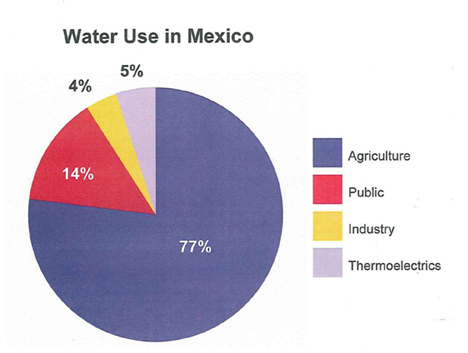 There are several factors that contribute to the extensive use and
excessive waste of water by Mexican agriculture. The most obvious
causes are the low price of water for Mexican farmers and the lack of
accurate measurement of water consumption. Without adequate
metering technology and despite the lack of water in different regions
of the country, farmers only pay a very small part of their water cost,
paying a base rate that serves as a poor, low estimation of their
consumption.
There are several factors that contribute to the extensive use and
excessive waste of water by Mexican agriculture. The most obvious
causes are the low price of water for Mexican farmers and the lack of
accurate measurement of water consumption. Without adequate
metering technology and despite the lack of water in different regions
of the country, farmers only pay a very small part of their water cost,
paying a base rate that serves as a poor, low estimation of their
consumption.
There is another somewhat unique Mexican factor that leads to this misuse. The low volume assignations due to low levels of water in dams creates an interesting phenomena. Under this circumstance, when Mexican farmers irrigate their crops, they extend the irrigation time to ensure that their fields get an exaggerated amount of humidity in case water is not available at the later, programmed time.
A final factor is the need for modern irrigation methods and the training of Mexican farmers in irrigation processes which could and should be an important part of the solution for these problems. It is estimated that these efforts could impact the total amount of agricultural water loss by as much as 60-70%.
Analysis of Mexican Water Basins and Regions
For our analysis, we divided the country into 5 regions that group
states with similar characteristics like weather, population, and
aquifer resources with each region including two or more basins:
Hydro-Agriculture Infrastructure
The Mexican hydro-agricultural infrastructure has the following
characteristics. There are over 4000 dams in Mexico from which 667 are
classified as large dams according to the International Commission on
Large Dams (ICOLD). The storage capacity of dams in Mexico is 150
billion m3 with the 100 most important dams having a total capacity of
118 billion m3, representing 79% of the total storage capacity in the
country. Of these top 100 dams, 36 are used exclusively for
agricultural purposes while 44 are used for agricultural and other
purposes.
During 2008, the irrigated land represented 25% of the total national
agricultural land surface, while the other 75% was fed from seasonal
water sources. Nonetheless, the production value of irrigated
land represented over 60% of total production. Regarding the
total amount of water extracted from aquifers, 69% is used for
agricultural irrigation.
In Mexico, the infrastructure areas of irrigation represent 6.5 million
hectares making it the 6th most irrigated country in the world.
Of the surface with irrigation infrastructure, 54% corresponds to 85
Irrigation Districts (IDs) and 46% to the more than 39 thousand
Irrigation Units (IUs). The IDs and IUs - defined below - use almost
the same volume of water, with the Districts using 48.5% of the total
volume of water assigned for the agricultural sector, and the Units use
the 51.5%.
Water Irrigation Systems, Distribution and Productivity in Mexico
Irrigation Districts (IDs) - Of the 6.5 million hectares with
irrigation infrastructure, 3.5 million (54%) correspond to 85 IDs.
Those IDs are located in almost every state except for Campeche,
Tabasco, and the Federal District. Almost 75% of the ID areas is
concentrated in 6 states: Sinaloa, Sonora, Tamaulipas, Michoacan, Baja
California y Guanajuato – four northern states and two central states.
The IDs are established under Presidential Decree and they are formed
by one or more surfaces whose perimeters enclose an irrigation
area. Said area or ID has hydraulic infrastructure works,
superficial and underground water sources and storage which can but do
not have to include more than one or several IUs. Each ID must
have a concession title that is provided to users (farmers) organized
as a User Civil Association (ACU) by Conagua. This concession gives
these ACUs the possibility to use a certain amount of water during the
year and establishes the source of said water. The main crops in
IDs are grains (corn, wheat and sorghum), sugar cane, beans, and to a
lesser extent, horticulture products generally fed with underground
water from private wells.
Most of the IDs are supplied by superficial water which from storage
dams and water channels. Each water basin has a Basin Council which
determines the volume of water that will be assigned to users depending
of the current dam storage realities. On the other hand, IU main water
sources are subterranean (aquifers) generally obtained from wells as
well as small dams and other small water storage bodies. And only 1/3
of the water utilized for agriculture which includes agriculture,
aquaculture, livestock, and other related areas, comes from
subterranean sources.
Irrigation Units (IUs) – Of the 6.5 million hectares with irrigation
infrastructure, 3 million hectares (46%) correspond to the more than
39,000 IUs. These IUs are agricultural areas with water infrastructure
although different from an ID in that they are commonly operated by
small land owners and communal farmers and that they obviously have
smaller land surfaces and both less and lower technology than the
IDs. IUs can be integrated by ACUs or other entities organized to
provide irrigation services and operate hydraulic infrastructure works
for the reception, conduction, regulation, distribution and dispersion
of national water assigned to agricultural irrigation.
Water productivity in IDs and IUs is a key indicator to evaluate the
efficiency in the use of water for agriculture. Said productivity
includes the efficiency in driving the water from the source to the
field and its use directly in the fields which is where the majority of
the way, as much as 70%, is lost. In general, the
productivity of irrigated areas is 3.7 times higher than those fed with
seasonal water sources. Despite the fact that irrigated areas are
substantially less than those fed by seasonal sources, irrigated land
generates more than half of the national agricultural production.
Conagua reports that the average productivity in irrigated areas is
about 27.3 ton/hectare, significantly higher than in the seasonal
surface of 7.8 tons/hectare. However, according to contacts in
the industry, while they confirm this 4 to 1 difference in the
productivity, they indicate that said productivity per ton is probably
closer to half of the figures provided by Conagua.
IUs as well as IDs were established and designed according to
technology for the distribution of water by gravity systems. In many
cases, they only built channel networks and principal drainage systems
leaving the rest of the infrastructure works in the fields to the
users. This situation together with accumulated deterioration from
several decades of insufficient spending on preservation and
maintenance programs generated a backlong of essential rehabilitation
requirements that led to a dramatic drop in the efficiency of
agricultural and general Mexican water management.
Irrigation methods are rudimentary or traditional in more than 80% of
Mexican surface (superficial) irrigation and their efficiency in terms
of water use is very low, somewhere between 33 to 55%. With the use of
better techniques and irrigation infrastructure modernization,
the water use efficiency could increase to 50 to 65%, which would
notably lower the extraction of water from Mexican aquifers and allow
these water savings to be used in other applications like the better
preservation of rivers, lakes and aquifers.
The intensity in the use of land for agriculture is an important
characteristic to review when analyzing IDs and IUs. A great part of
the IDs are cultivated twice a year in the crop cycles autumn-winter
and spring-summer. Nonetheless, some districts are only harvested once
a year. In 92% of IUs, with their water source being superficial
waters often based on season water sources, only one harvest is
programmed due to the lack of water, further exacerbated by the
increase non-agricultural water demand, the regular uncertainty of
availability, and the drop in the pumping levels. Conagua
officials insist that this very high percentage can be reduced through
technical irrigation assistance programs for producers as well as the
substitution of crops with much lower water demands such as barley and
chickpea.
Conagua Budget for Hydro-Agricultural Infrastructure
In the last five years (2006-2010), the general Conagua budget was
increased almost 210%. Meanwhile, the budget for
hydro-agricultural infrastructure during this period was increased
almost 237% with double figure annual inceases demonstrating how
Conagua recognizes the importance and severe problems of water in the
agricultural sector. Below is the breakdown of the Conagua budget
during the last five years and the budget information for 2011:
| YEAR | TOTAL BUDGET (Billions of Pesos) |
ANNUAL INCREASE |
BUDGET FOR AGRICULTURE (Billions of Pesos) |
ANNUAL INCREASE |
| 2006 | 16.6 | 3.8 | ||
| 2007 | 19.5 | 18% | 4.8 | 26% |
| 2008 | 29 | 48% | 5.7 | 18% |
| 2009 | 32 | 10% | 8 | 40% |
| 2010 | 35 | 9% | 9 | 12% |
| 2011 | 36.4 | 4% | N/A | N/A |
The Mexican federal government has increased Conagua resources in recognition of the importance of water issues at all levels and in light of the increasing need for potable water treatment, wastewater treatment and water infrastructure. Regarding hydro-agricultural spending, said funding is designated to create and maintain water and wastewater infrastructure, to introduce new water technology and irrigation infrastructure improvements, and to better train users on the benefits of these technologies and improvements. In the next few years, the need for a more efficient agricultural system will be an even greater priority due to the increase of the population that requires both more food and more water, both of which they can obtain from a more efficient Mexican agricultural system.
In our next edition, we will expand one some of the above issues and discuss some other important hydro-agricultural issues in Mexico.
Mexico City, known officially as the Mexican Federal District (DF), is one of the largest cities on the planet with more than 10 million inhabitants although less than half of the size of the Valley of Mexico which includes another 10 million people. Due to these numbers, the major problem which it faces is rooted in the lack of public services and the water sector is no exception.
Continuous urban growth and a lack of local water sources and other
factors have negatively affected the water supply, and deliver and
drainage systems for the entity. The Federal District Water System
faces considerable challenges in its attempt to repair leaks and treat
waste water. In addition, if one bears in mind that 70% of the water
supply comes from the aquifer subsystem located underground the city,
one begins to understand the problem of the regular if not constant
floods provoked by the land sinkage product of the overexploitation of
the aquifer subsystem. This continuously uncontrolled water flows lead
to infrastructure damages especially to the potable water and
sewer/drainage networks. This together with the inadequate management
of municipal and industrial waste paints a worrisome picture for the DF
water system.
This article will present the current status of the DF water system in
relation to existing infrastructure and the future needs for future
potable water, potable water and sewer/drainage systems, and potable
water and waste water treatment plants.
Potable Water Situation in Mexico City
The Federal District Water System is responsible for the supply of
potable water and the storage and management of waste water in the DF
whereas Conagua, its federal counterpart, is entrusted to provide the
water in block to the DF to operate and maintain the great majority of
deep wells and to organize large and interstate and interbasin
hydraulic projects.
Despite the existence of 11,000 kms of distribution lines and more than 300 storage tanks with a capacity of more than 1.5 million cubic meters (m3), many DF inhabitants depend on non-water system sources lke tanker trucks or local wells and springs to obtain potable water. Likewise, approximately 40% of the southern part of the DF does not have access to sewer or potable water systems. Also, there exists the problem that the DF loses 50 % to 60 % of its potable water between its source and the end-user in the distribution system, As a result, there is a latent need for the construction of new distribution infrastructure and the repair of the existing system.
Before continuing our analysis of DF infrastructure, projects, and
budget issues, it is important to mention the vital role that the Lerma
– Cutzamala System plays for the DF. This system was constructed to
help avoid the overexploitation of the aquifer of the Valley of Mexico,
transporting waters from the Cutzamala River to the Federal District
via the Peripheral Aqueduct. The water imported is disinfected with
chlorine and then incorporated into th Lerma-Cutzamala aqueduct before
joining the DF potable water distribution system. The Lerma-Cutzamala
System possesses 7 dams, 6 macro pumping plants, almost 73 kms of open
channels, 44 kms of tunnels, 218 kms of aqueducts and the Los Berros
water treatment plant that, being the largest potable treatment plant
in Mexico, it provides 1.5 billion liters of water to Mexico City,
equivalent to 26% of the total DF water supply. Despite the incredible
size and dynamic of Lerma-Cutzamala, this infrastructure has turned out
to be insufficient to continue to meet the basic, total needs of the
DF. As a result, the DF and Conagua authorities continuing
working on new water source supplies to resolve this problem.
The DF potable water supply is shaped by external and internal sources
located in Mexico City/DF, the State of Mexico which surrounds the DF
and the State of Michoacán which neighbors the State of Mexico.
The external sources are superficial waters and represent 35% of the
total DF system. Internal sources consist of the local aquifer
which represents the other 63%, composed of the Lerma-Cutzamala and the
Mexico City aquifer.
The biggest problem that the DF distribution system faces is the loss
of potable water which can reach upwards of 60% of the total water in
the distribution system. This permits many DF zones to be without water
service or with intermittent service. The important DF
delegations or city subdivisions/boroughs of Álvaro
Obregón, Coyoacán and Cuajimalpa are the major but not
only delegations that feel the affect of these problems.
In a city where the population grows almost unabated and where the
geography is very irregular and thus impedes the delivery of water to
its inhabitants, the need to have an more efficient potable water
system and a reliable distribution system is clear. In addition, the
excessive DF aquifer extraction has forced DF and Conagua officials to
bring water into the DF from basins outside of the Valley of
Mexico. In light of the uniquely high and difficult DF terrain,
bringing in water from outside of the Valley of Mexico has provoked the
need for the construction of 227 pumping plants to get water to the 1.5
mile high city and then to provide water to its even higher areas.
The DF potable water distribution system is made up of a principal and
secondary network. The principal network has 690 kms of pipelines of
between .5 and 1.7 meters in diameter. The secondary network has more
than 10,000 kms of pipelines of .5 meters in diameter along with 243
storage tanks with a 1.5 million cm2 capacity. The DF Water System's 27
treatment plants and 377 chlorination stations supply close to 35,000
liters of potable water per second but this only meets 90% of the
potable water requirements of its inhabitants. The DF potable water
supply has always been problematic but this has been accentuated in
recent years but some extreme drought conditions. As a result, the DF
invested only a modest sum, 1 billion pesos ($ 83.3 million USD) in
2009, to begin the rehabilitation of potable water
lines.
For the improvement of the potable water supply, the DF has a total
budget through 2012 of 4.47 billion pesos ($373 million USD).
From these funds, Wisconsin's Trade Office in Mexico expects more
related works during 2011 and 2012. It is important to mention that
these funds are strictly DF funds and additional Conagua funds for
these projects will make total available money more than double the
above mentioned amounts. While DF potable water projects will
move forward in 2011, it is important to mention that an even greater
ongoing priority is in the rehabilitation of the DF deep drainage
system.
Deep Drainage System Situation in Mexico City
The DF system for carrying waste water out of the Valley of Mexico
consists of three areas: (a) the above-ground Great Canal, (b)
complementary river systems (principally the Hondo River, the
Churubusco River, and the De la Piedad River) and (c) the subterranean
Deep Drainage System. The DF Deep Drainage System was constructed
in 1967 and put in operation in 1975. It is made up of a 6.5
meter in diameter tunnel designed originally to remove waste water and
rain.
Originally, it was designed to work exclusively during the rainy season
and that during the low water season, it could be closed for
inspection, cleaning and maintenance. However, due to some
regional collapses in lands affected by these structures, it has not
been possible to inspect these tunnels as had been hoped. And,
last year, when the tunnel was temporarily closed for some partial
inspections during the dry season, an unexpected heavy rain occurred
and severe flooding occurred in the eastern part of the city.
In general and as a result of this very controversial flooding
incident, the attention of the water sector has refocused extensively
on the rehabilitation of the DF deep drainage tunnels. As a
result, DF investment on potable water infrastructure decreased last
year by more than 50% vs 2009 totals, with said funds being transferred
to Deep Drainage System projects.
This system includes a Central Issuer Channel, 9 interceptors with a
length of 154 kms. Below is a table that shows general
information about this system.
| DF Deep Drainage System | Length (Km.) | Diameter (m) | Capacity (m3/s) |
| Central Emission Tunnel |
50.0 |
6.5 | 220 |
| Central Interceptor |
16.1 |
5.0 |
90 |
| Interceptor Center-Center |
3.7 |
5.0 |
90 |
| Interceptor East |
22.2 |
5.0 |
85 |
| Interceptor Center - East |
16.0 |
4.0 |
40 |
| Interceptor - West |
16.5 | 4.0 |
25 |
| Interceptor Iztapalapa | 5.5 | 3.1 | 20 |
Waste Water Situation in Mexico City
Another one of the serious problems that the DF Water System has to
face is the lack of waste water treatment and treatment capacity.
Currently, there are 25 waste water treatment plants in the DF with an
installed capacity of 6,640 lps. However, the capacity of these plants,
2,500 lps, represents only 38% of the capacity that would be needed to
treat total DF waste water volumes. With this limited capacity and with
the vision of treating DF waste water in Atotonilco, outside of the
Valley of Mexico, it is not all that surprising that only 7% of DF
waste waters are currently treated.
There are 6 waste water treatment plants in northern Mexico City with a
combined installed capacity of 700 lps. In the central area, there are
5 plants whose combined installed capacity is nearly 5 000 lps, with
the “Cerro de la Estrella” plant being the largest of these plants with
80% of the total capacity in the central area. Finally, in the southern
area, there are 5 plants with a combined installed capacity of 800
lps. It is important to mention that 5 billion pesos ($416.6
million USD) is currently programmed for the installation of new
technology and to increase the production of treated waste water from
2.5 m3/s to 7.2 m3/s by 2012. In the future, the DF hopes that
this water treatment will result in important, additional water reuses
which will alleviate some DF aquifer concerns and eventually recharge
aquifers.
Another challenge has to do with the storage of waste water prior to
its treatment or delivery outside of the Valley of Mexico. Most
waste water storage areas are located in the northern part of the city
where all DF waste water is directed on their way out of the Valley of
Mexico. However, this leads to an uneven, less than ideal distribution
of waste water storage. To address this the DF has launched
projects to add other reserve basins especially in the Iztapalapa area
in the southern part of the city.
With recent flooding problems, the DF budget priority has been somewhat
away from treatment plants and towards the rehabilitation of deep
drainage system tunnels. However, the DF has made the
rehabilitation of its existing waste water treatment plants, such as
the “Milpa Alta” in southern part of the city, a priority as
well. On the potable water side, an important project is the
construction of a potable water treatment plant in “Cerro de la
Estrella”, in the south area of the city, which seeks to build an
infiltration pond and to return this treated water to the aquifer – the
first effort of its kind in Mexico. In addition, the DF has sought to
invest in wetlands construction and similar “swamps” for waste water
maintenance, especially in the water abundant areas of Xochimilco and
Tlahuac in the southern part of the city which they hope will also help
in with water level issues in these wetland areas.
Conclusion
With the above information on DF potable water, waste water, and water
treatment issues, we can get a glimpse of the DF water system and
infrastructure challenges. These problems must be attacked on all
fronts as they are circular problems. The exploitation of the DF
aquifer for drinking water makes Mexico City land continue to sink, in
some areas as much as 30 cm per year. With the fall in ground
water levels, it is necessary to pump deeper producing lower quality
water creating further land degradation which increases operation,
maintenance and water purification costs. In addition, the supply and
drainage network are affected as land subsidence creates more pressure
and leads to cracks and fissures that causes 50-60% potable water loss.
When you combine these problems with the lack of wastewater treatment
and a growing population, one can visualize the seriousness of the
challenge that the DF Water System faces – and the level of assistance
that they are likely to require from domestic and foreign companies to
help solve these problems.
The DF and Conagua have increased their budgets for DF water projects
during the last few years with Conagua funding of DF water projects as
its top priority, doubling funding from just over 5 billion pesos in
2009 to over 10 million pesos (over $800 million USD) in 2010.
This increase made the DF Conagua budget three times that of the State
of Mexico and larger than the budgeted funds for the next give most
important Mexican states. Still, these funds are clearly not enough to
solve these problems in general and because too many important DF
projects have had to be put off to address other more urgent and
politically sensitive water issues.
In response to these realities, there have been some initial proposals
to increase private sector participation in new infrastructure projects
and rehabilitation and maintenance programs. Although these measures
are still in planning stages, many water officials believe that this is
the only way to address the problems of water sector in the DF. These
types of programs will create more business opportunities for domestic
companies and for foreign companies to provide products and
technologies for better funded and therefore more generally stable
integrated projects and solutions.